Our study titled “Thermomorphic Hydrophilicity Base-Induced Precipitation for Effective Descaling of Hypersaline Brines” has been accepted for publication in ACS ES&T Engineering!
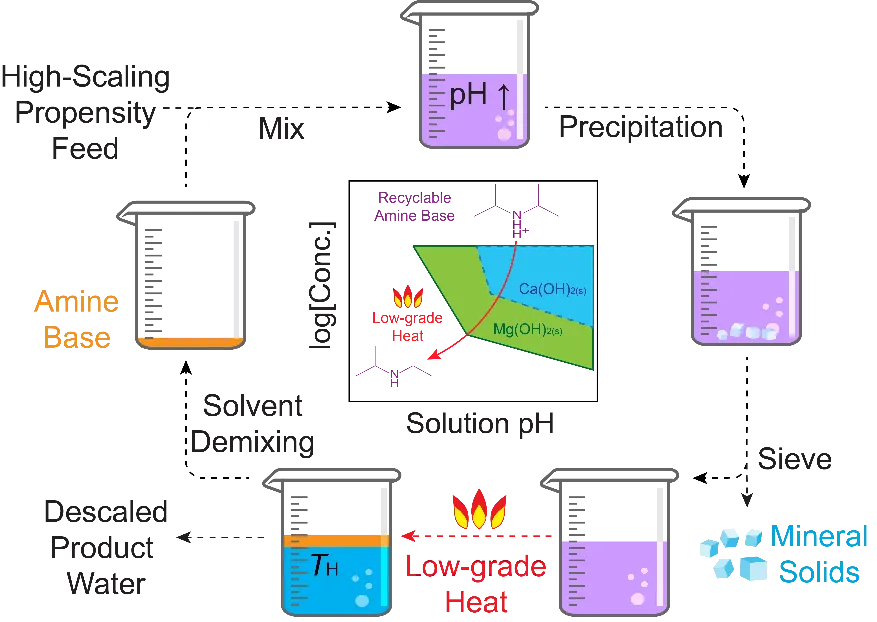
Our proof-of-concept article demonstrating the novel technology of thermomorphic hydrophilicity base-induced precipitation (THBIP) for the descaling of difficult-to-treat ultrahigh-salinity brines has been accepted for publication in ACS ES&T Engineering!
THBIP is an outside-the-box approach developed in our group for the effective removal of hardness ions from hypersaline brines with high-scaling propensity. The technique utilizes thermoresponsive amine bases for the controlled precipitation of scaling constituents in alkaline conditions and subsequently uses low-temperature heat to trigger the phase separation of amine from aqueous solution, thus enabling reuse of the base. Removal of hardness ions, Ca2+ and Mg2+, were systematically investigated with three amines exhibiting distinct properties: diisopropylamine, N-ethylcyclohexylamine, and N,N-dimethylisopropylamine. The study identified high miscibility in water, strong basicity, and sensitivity of hydrophilicity to temperature stimulus as the key factors affecting performance. Using a simulated hypersaline feedwater with 240 g/L total dissolved solids and of high-scaling propensity, THBIP achieved ≈80% hardness removal. The study demonstrates the proof-of-concept of using thermomorphic hydrophilicity bases as an alternative strategy to effectively reduce the scaling potential of hypersaline brines.