Our study titled “Donnan Dialysis Desalination with a Thermally Recoverable Solute” has been accepted for publication in ACS ES&T Engineering!
Our article proposing a novel desalination strategy driven by low-grade heat has been published in ACS ES&T Engineering.
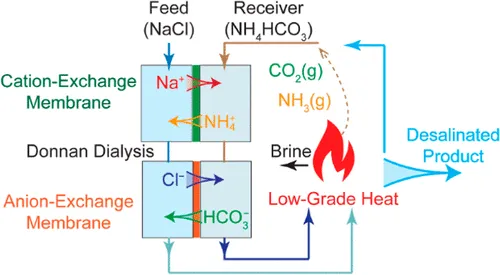
Using sustainable energy to drive desalination will lower the carbon intensity, an urgent need at the water-energy nexus. This study presents a novel desalination technology that couples Donnan dialysis with thermally-recoverable solutes and utilizes low-grade heat as energy input. In the proposed process, saline feed streams and receiver solutions of concentrated ammonium bicarbonate flow stepwise across cation- and anion-exchange membranes. Salt ions are separated from the saline stream, up a concentration gradient, through charge exchange with the thermally recoverable ions by Donnan dialysis. Warming the two outlet streams using low-temperature thermal sources volatilizes ammonia and carbon dioxide, thus removing ammonium bicarbonate to yield desalinated product water and concentrated brine. The study experimentally demonstrated proof-of-concept of the technique and analyzed the achievable performance. This technology can potentially be utilized for fit-for-purpose applications, e.g., agricultural irrigation, to address the rising water demand and opens up opportunities to lower the carbon intensity of desalination.