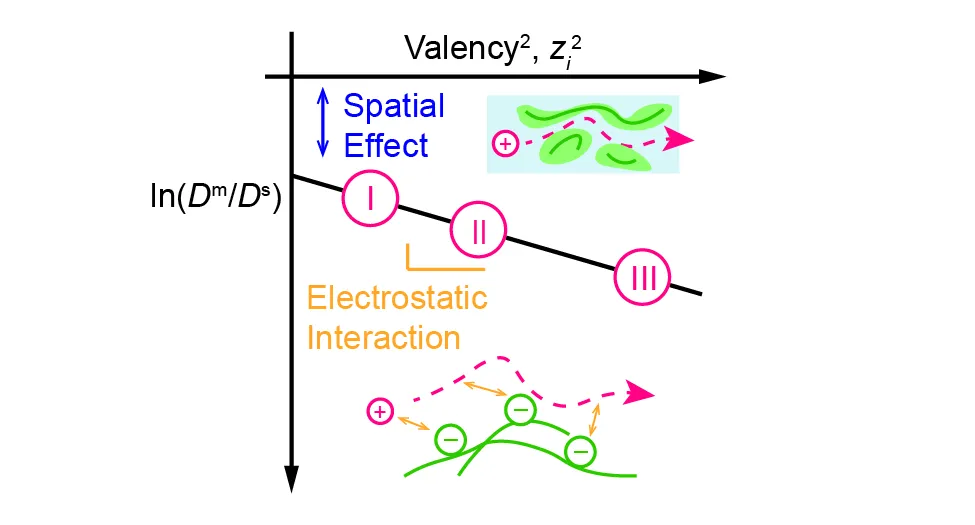
Our study titled “Counterion Mobility in Ion-Exchange Membranes: Spatial Effect and Valency-Dependent Electrostatic Interaction” has been accepted for publication in ACS ES&T Engineering!
Our article investigating counterion mobility in ion-exchange membranes (IEMs) for ion separations has been published in ACS ES&T Engineering.
Fundamental understanding of the ion transport phenomena is necessary to inform the development of ion-specific selectivity in IEMs for environmental, energy, and water applications. In this study, a first-principles-based transport framework is presented to describe the migration mobility of counterions, which are the primary charge carriers, in IEM. We derived a concise analytical expression to represent the two governing mechanisms of i) spatial effect of available fractional volume for ion transport and ii) electrostatic interaction between mobile ions and fixed charges. The proposed transport model showed good agreement with the experimentally characterized mobilities of counterions with different valencies. The investigation revealed that the order-of-magnitude difference in mobilities observed between mono-, di-, and trivalent ions can be accurately modeled by the migration of mobile counterions down a rough electric potential gradient. Crucially, the approach can be utilized to analyze the structure-property-performance relationships, quantitatively bridging ion migration mobility to intrinsic membrane characteristics, such as charge density, water uptake, and dielectric constant.