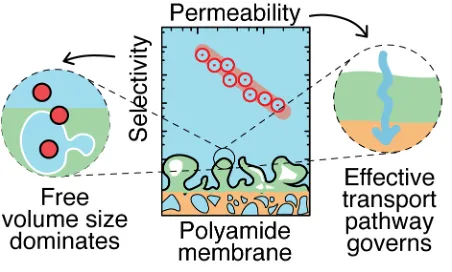
Our research elucidating the roles of reverse osmosis membrane structural properties in the permeability-selectivity tradeoff has been published in ACS ES&T Engineering!
Our research article relating the influence of membrane structural properties to the permeability-selectivity behavior of reverse osmosis membrane has been published in ACS ES&T Engineering!
Understanding the membrane transport mechanism is a critical step to guide the advancement of membrane materials used in reverse osmosis (RO) desalination and water treatment. Our study investigates the roles of the polyamide RO membrane structural properties in the intrinsic permeability-selectivity behavior. Our experimental characterization and analysis reveal that the free volume element (FVE) size only slightly increased for more permeable membranes, but the marginal size enlargement cannot fully account for the permeability trend. Instead, shortening of the effective transport pathway is identified as a principal factor governing water permeation. On the other hand, membrane selectivity is found to be dominated by FVE size and is essentially independent of the transport pathway. Lastly, a framework reconciling experimental evidence with transport theory is proposed to relate the influence of membrane structural properties on the permeability−selectivity tradeoff. Findings of this study provide fundamental insights for understanding the transport phenomena in aqueous separation membranes.