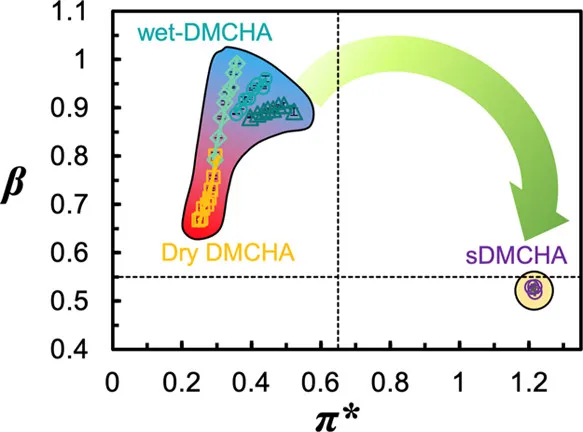
Our joint research study examining the tunable polarity of switchable hydrophilicity solvents has been accepted for publication in ACS Sustainable Chemistry Engineering!
In collaboration with Lindsay Soh’s group at Lafayette College, we studied the thermoresponsive polarity of N,N-dimethylcyclohexylamine (DMCHA) using Kamlet-Taft solvatochromic parameters and dielectric constants. The temperature-sensitive hydrophilicity of DMCHA can be utilized for more sustainable extractions, such as temperature swing solvent extraction to desalinate difficult-to-treat hypersaline brines. However, the genesis of the temperature-dependent polarity is poorly understood. Our research revealed that the hydrogen bond accepting ability of DMCHA decreases substantially as the temperature increases. Importantly, the investigation provided compelling evidence to show that DMCHA interacts synergistically with water and, consequently, dipolarity/polarizability of the mixture decreases more dramatically with higher temperatures than in either pure substance. Mechanistic understanding of the thermoresponsive phenomenon can inform the development and selection of switchable hydrophilicity solvents for tailored solvent extraction processes, where the potential energy savings and recyclability of such solvents may offer greener alternatives to conventional separations.